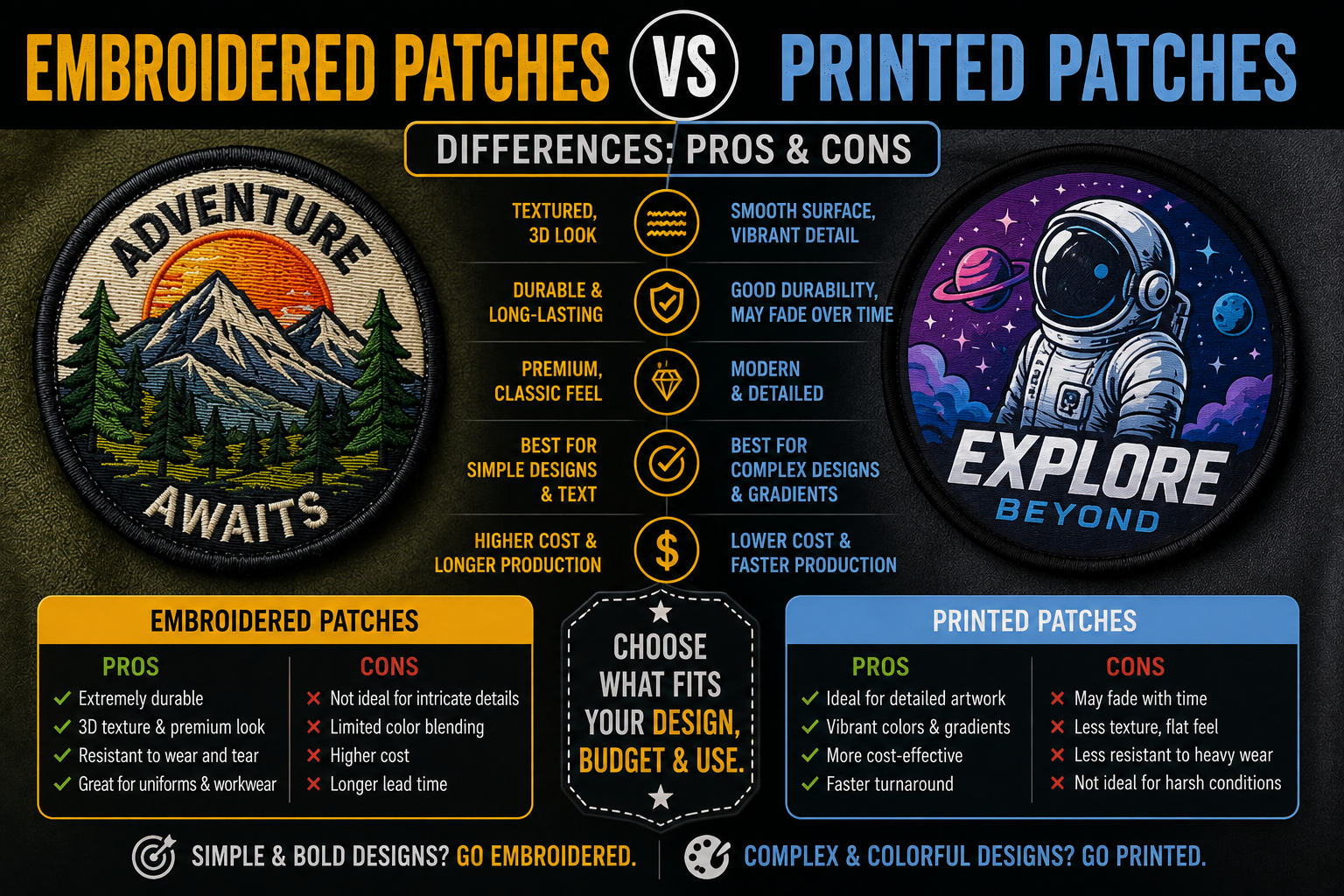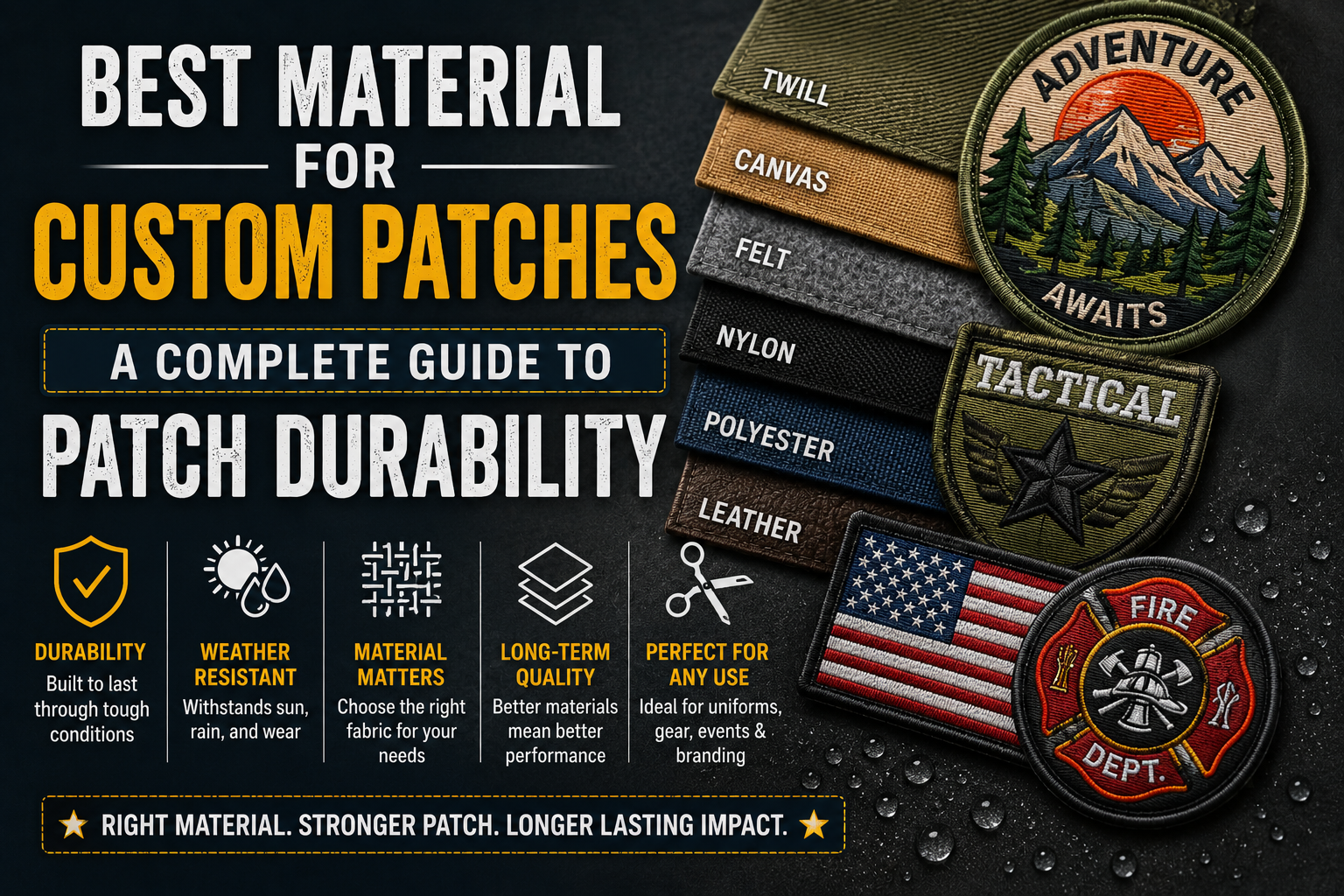
Best Material for Custom Patches: A Complete Guide to Patch Durability
Choosing the right material for your custom patch is one of the most important decisions you'll make, and easily one that's often overlooked. The material directly determines how long your patch lasts, how it looks, and whether it holds up to washing, outdoor exposure, and daily wear.
Whether you're ordering custom embroidered patches for uniforms, custom leather patches for premium workwear, or custom PVC patches for tactical gear, this guide breaks down the best materials available and helps you make the smartest choice for your specific needs.
Why Material Matters for Patch Durability
A patch is only as good as what it's made of. Poor materials lead to:
- Fading colors that make the design unreadable
- Fraying edges that unravel the patch
- Peeling or cracking in patches with printed elements
- Delamination of iron-on backing
- Shrinking or warping after washing
The right material eliminates all of these issues. Here's a comprehensive look at every major patch material and how each one performs.
1. Embroidered Thread on Twill Backing: The Classic Standard
Best for: Uniforms, military, police, corporate branding, general use The most common and time-tested patch material is embroidered thread stitched onto a woven twill backing. The backing is typically made of polyester twill, which is:
- Resistant to fraying
- Dimensionally stable (doesn't stretch or warp)
- Compatible with iron-on, sew-on, and Velcro backings
The thread itself is polyester or rayon, both of which hold color exceptionally well. Polyester thread is slightly more durable and moisture-resistant, while rayon thread has a shinier, more vibrant finish.
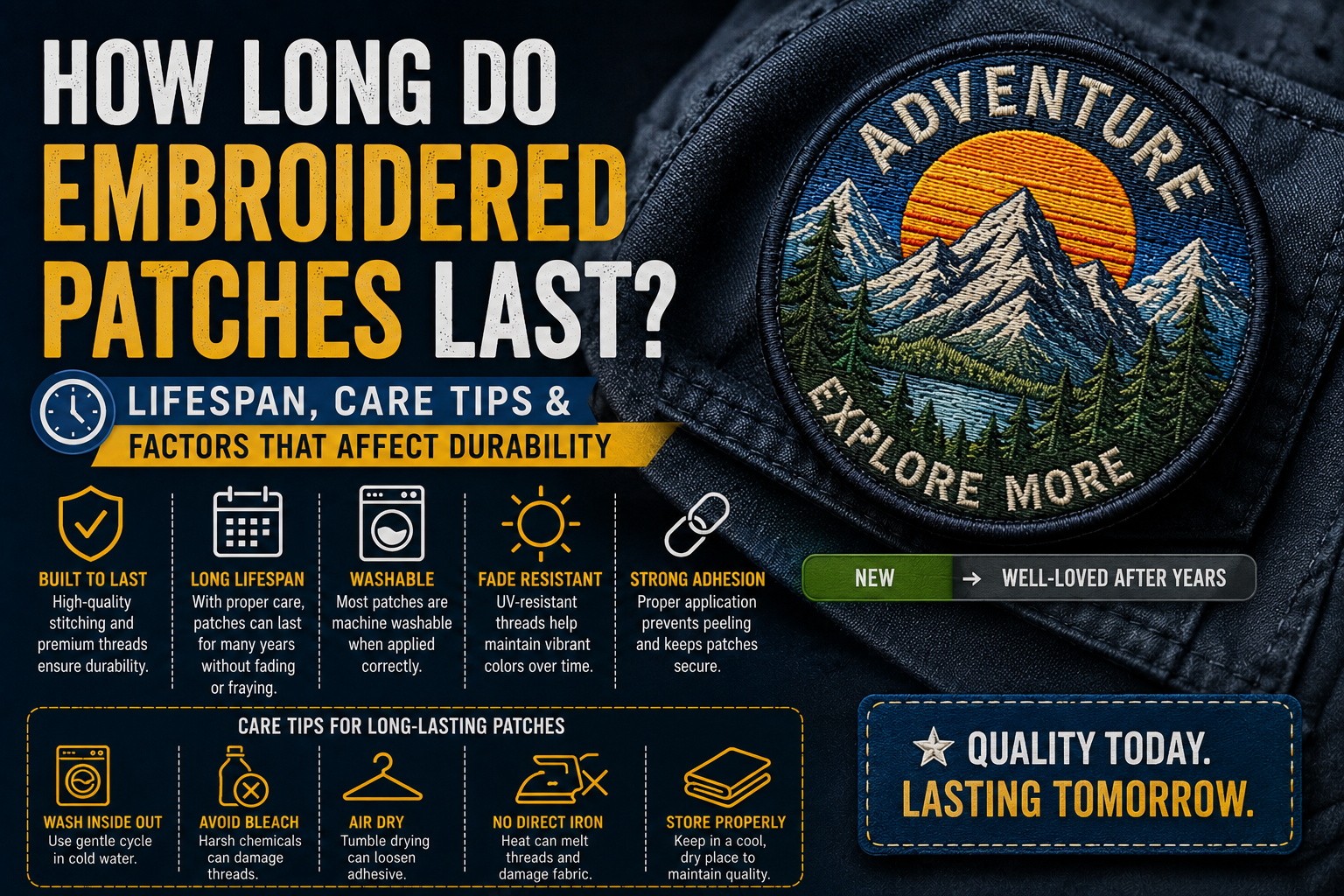
Durability rating: Excellent. Properly made custom embroidered patches can last a decade or more with normal use and care.
Ideal thread coverage: 75–80% or higher ensures the patch looks substantial and the backing is well protected.
2. PVC (Polyvinyl Chloride): The Weatherproof Workhorse
Best for: Tactical, military, outdoor, extreme weather environments
Custom PVC patches are made from soft rubber-like plastic. They are:
- 100% waterproof
- UV-resistant (colors don't fade in sunlight)
- Scratch-resistant
- Flexible without cracking
PVC patches are molded in layers to create a 3D relief effect, giving them a bold, dimensional appearance. They're virtually indestructible in outdoor conditions, which is why they're a top choice for custom military patches, tactical gear, hiking apparel, and first responder equipment.
Durability rating: Exceptional for outdoor use. PVC patches outlast embroidered patches in harsh weather conditions.
Limitation: The molded design has slightly less fine detail capability compared to embroidery for very intricate artwork.
3. Leather: The Premium Performer
Best for: Denim jackets, biker gear, premium workwear, fashion brands
Custom leather patches are made from genuine or synthetic leather and offer a completely different aesthetic: one that suggests quality, heritage, and craftsmanship. Leather patches are either:
- Embossed — Design raised above the surface
- Debossed — Design pressed into the leather
- Laser engraved — Burned into the surface for ultra-fine detail
- Printed/painted — Full color designs on leather
The Debossed vs Embossed Leather Patches comparison is worth understanding before ordering: debossed gives a subtle, refined look common in luxury brands, while embossed creates a more dramatic, tactile effect.
Durability rating: Very high. Genuine leather ages beautifully and can outlast the garment it's attached to. Faux leather is nearly as durable and more moisture-resistant.
Best attachment: Sew-on. Iron-on adhesive doesn't bond as reliably to leather backing.
4. Woven Fabric: Fine Detail at Low Profile
Best for: Name tags, small logos, text-heavy designs, high-detail artwork
Custom woven patches are made using a weaving process rather than stitching. Instead of thread looped over a backing, the design is woven directly into the fabric. This allows for:
- Extremely fine detail (text down to 4pt font size)
- Smooth, flat surface without raised texture
- Very thin, lightweight construction
Woven patches are made entirely of thread, with no separate backing fabric, making them highly flexible and lightweight.
Durability rating: Excellent. Woven patches are extremely resistant to fraying and color loss. For a deeper look at the differences, explore Embroidered vs Woven Patches to understand which suits your specific project.
Limitation: Less dramatic visual impact than embroidered patches; not ideal for designs where texture and dimension are important.
5. Chenille: The Varsity Classic
Best for: Letterman jackets, school spirit, sports teams, youth organizations
Custom chenille patches are made with a looped, fuzzy yarn stitched onto a wool or felt base, the iconic texture of varsity patches. The wool felt backing is:
- Thick and sturdy
- Easy to sew onto garments
- Available in a wide range of colors
Chenille gives patches a warm, tactile quality that's completely distinct from embroidery.
Durability rating: Good. Chenille patches hold up well with gentle care, but the fuzzy surface can mat down over time with heavy use or improper washing. They're not suited for outdoor or high-abrasion applications.
6. Sublimation: Full-Color Photography on Fabric
Best for: Complex, photographic, or gradient-heavy designs Custom sublimation patches use a heat-transfer printing process that bonds dye directly into the polyester fabric. This enables:
- Full-color, photographic image quality
- Gradients and shading not possible with thread
- Exact brand color matching
Durability rating: Good to very good. Sublimated colors are embedded in the fabric and won't peel. However, they can fade faster than embroidery with prolonged UV exposure and heavy washing.
Best use case: Designs with photographic elements, complex gradients, or more than 8 colors where embroidery would be prohibitively expensive.
7. Sequin: The Show-Stopper
Best for: Fashion, events, costumes, entertainment Custom sequin patches use small, shiny discs sewn onto a fabric backing to create eye-catching, reflective designs. They're 100% about visual impact and are typically used in:
- Fashion apparel
- Stage and performance costumes
- Event merchandise
- Decorative accessories
Durability rating: Moderate. Sequins can be dislodged with rough handling. These patches are not designed for high-wear utility applications. To understand more about what makes these patches unique, see What Are Custom Sequin Patches?
8. Appliqué: Bold at Scale
Best for: Large patches, back patches, biker patches, oversized logos Custom applique patches combine fabric cutouts with embroidered borders and detail stitching. The base of the design is a piece of colored fabric (felt, twill, or other material) that's cut to shape and then outlined and detailed with thread.
This technique allows for very large patches with bold color fills without requiring millions of stitches, which keeps them lightweight and fast to produce.
Durability rating: Excellent. The combination of fabric base and embroidered detail gives these patches long-lasting structure.
Which Material Is Best for Maximum Durability?
For pure, all-around durability across most conditions: polyester-threaded embroidered patches on twill backing are the gold standard. They offer the best combination of color retention, structure, and versatility.
For outdoor and extreme weather durability: custom PVC patches win outright.
For premium longevity with a luxury aesthetic: custom leather patches are unmatched.
Order Your Custom Patches with Confidence
Choosing the right material is the first step. The next is finding a supplier who delivers on quality. Custom Embroidered Patches Hub offers all major patch types with expert guidance on material selection, so you always get the right patch for the right purpose.
Frequently Asked Questions
What is the most durable backing for a custom patch?
Sew-on backing is the most durable attachment method. For a deeper dive into your options, explore backing for patches to choose the right one for your garment and use case.
Are PVC patches better than embroidered patches for outdoor use?
Yes. PVC patches are fully waterproof and UV-resistant, making them superior for outdoor, tactical, and military applications.
Can I combine materials in one patch?
Yes. Appliqué patches, for example, combine fabric bases with embroidered detailing. Hybrid approaches are possible depending on your design requirements.
Conclusion
The best material for your custom patch depends entirely on where it will be worn, what it needs to withstand, and the look you're going for. Understanding your options (from classic embroidery to custom 3D embroidered patches, from leather to PVC) gives you the power to choose the right patch for the right job, every time.
Need a patch design that fits your brand?
This is the end-of-article conversion section. Repeat the core value props and give one clear next step.
- Free design support
- Fast turnaround
- Made in USA quality
- No setup stress